
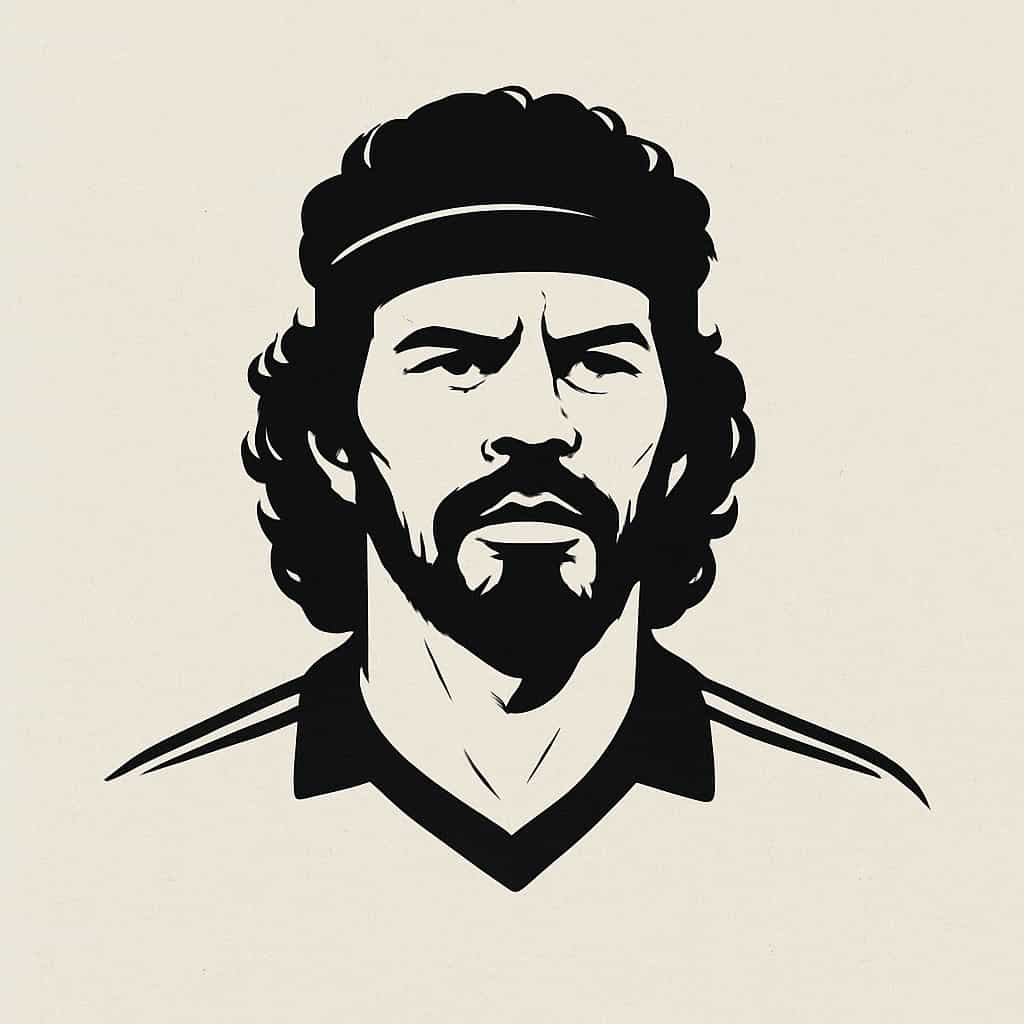
It is much better to try, I believe, than to conform.
Sócrates Brasileiro Sampaio de Souza Vieira de Oliveira was born in Belém, in the north of Brazil, and became exactly what the name promised: a thinker who happened to play football better than almost anyone alive.
He qualified in medicine in 1977 at Ribeirão Preto — his club, Botafogo-SP, excused him from training so he could study — and then spent six years at Corinthians scoring 172 goals in 297 games. He was six foot four, chain-smoked, wore a headband carrying whatever message needed carrying, and passed the ball backwards with his heel without looking, which remains the most elegant act in the sport.
The moments
1982
A captain, a headband, a golden team
He led Brazil at the 1982 World Cup — Zico, Falcão, Éder, and the most beautiful football the tournament has seen. Against the USSR in Seville on 14 June he equalised from distance in a 2-1 win. Three weeks later Italy knocked them out at Sarrià, and the losers became immortal.
1982
One player, one vote
With Wladimir, and with the blessing of president Waldemar Pires and director Adílson Monteiro Alves, he turned Corinthians into a democracy. Everything went to a show of hands — signings, tactics, whether the squad had to be locked in a hotel before matches. They won the Paulista in 1982 and again in 1983.
1983
South American Footballer of the Year
Voted the continent's best player while running his club as a co-operative and his country's most public argument for democracy.
1984
The promise at Praça da Sé
At a Diretas Já rally in São Paulo on 16 April, he promised a crowd of over a million that he would turn down Fiorentina and stay in Brazil if congress passed direct elections. The amendment failed. He kept his side of the bargain and left for Italy.
2011
A title, and a goodbye
He died on 4 December of septic shock, aged 57. That same weekend Corinthians won the Brazilian championship — the club he'd turned into an idea, saluting him on the way past.
His younger brother Raí won the World Cup that Brazil never gave Sócrates. It doesn't matter. He spent a decade demonstrating — with his feet, and with a show of hands — that victory was always the secondary consideration.